Anyone Can Build a Website. Not Everyone Can Build One That Works.
Every few months, a new tool promises the same thing: build a professional website in an afternoon, no developer required. Drag a few blocks into place, choose a template, type a prompt.
The barrier to publishing something online has never been lower.
This is true. It is also beside the point.
Anyone can build a basic website. Building an effective, secure, accessible, high-performing website that supports business goals is a professional skill.
These are not two versions of the same task. They are two different categories of work, and the gap between them is where most organizations get into trouble.
Where this gap actually shows up
It’s common for a small or mid-size museum, nonprofit, or local business to be running on a builder platform, usually for understandable reasons.
A board member or founder set it up years ago.
There’s no dedicated communications or marketing role to own it.
The budget went toward the mission, not the website.
None of that is a mistake. It’s how most organizations start.
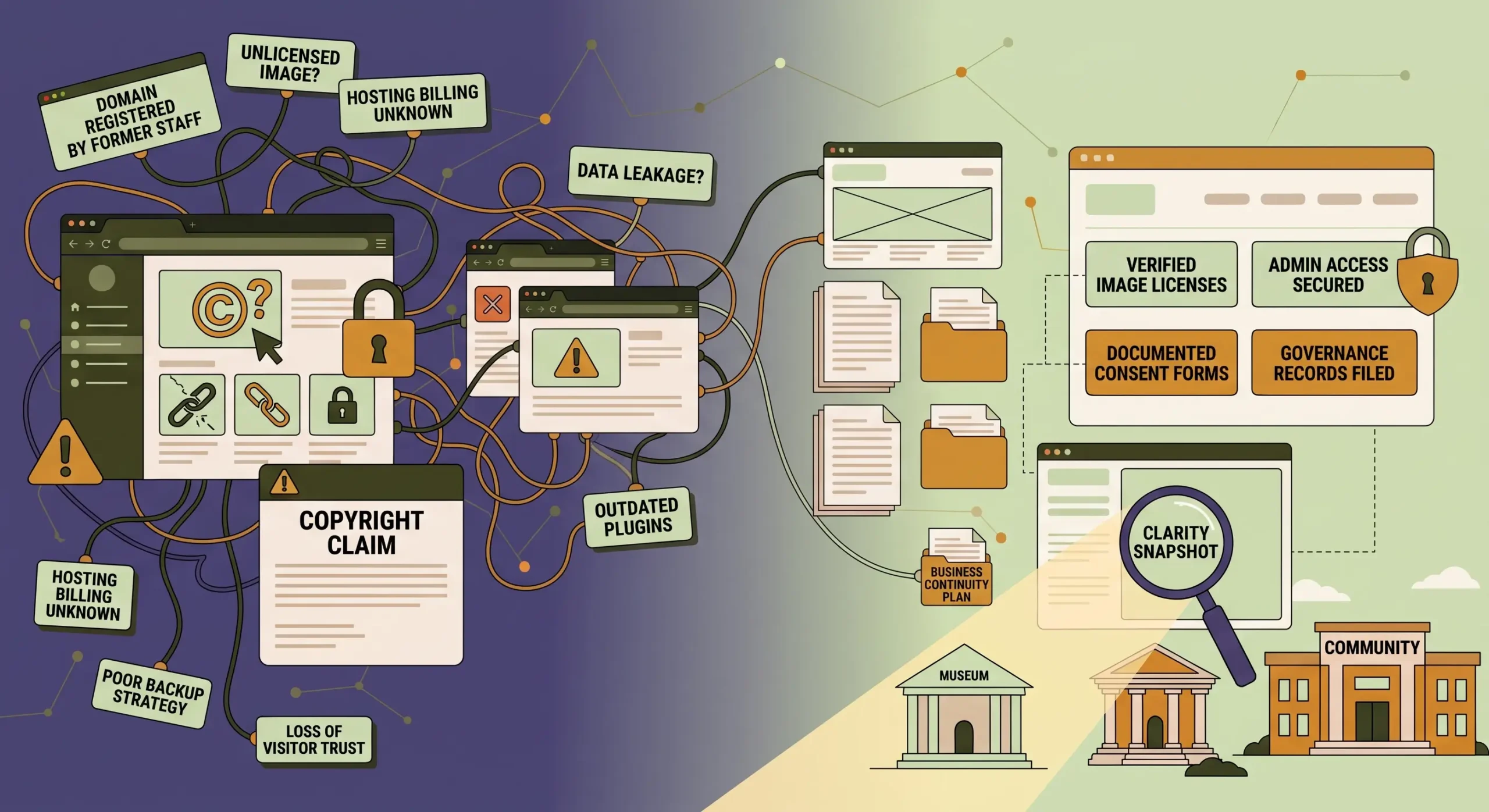
The trouble shows up later, when the organization has grown past what that original setup was built to do, when the website is now the first place a funder checks before a meeting, the place a board prospect looks before saying yes, or the place a customer decides whether to trust the business enough to buy.
The platform hasn’t changed. What the organization is asking it to do has.
What “anyone can build” actually means
What today’s builders and AI tools have genuinely solved is publishing.
A page can exist, look reasonably current, and go live without anyone touching code. That’s a real achievement, and it’s made the entry point to having a website nearly free.
But publishing a page is not the same as building infrastructure.
A website that exists is not the same as a website that performs the function it’s actually being asked to perform:
- earning trust with someone evaluating you for the first time,
- holding up under real traffic,
- working for people using assistive technology,
- loading fast enough that no one leaves before it does, and
- staying secure as the rest of the internet changes around it.
None of that is part of the drag-and-drop promise. It’s not supposed to be.
These tools were built to remove the cost of getting started, not to replace the judgment required to get it right.
What’s at stake, and for whom
The risk isn’t identical across organizations. It shows up differently depending on who’s actually evaluating the site:
For museums and nonprofits, the site is doing due diligence work before anyone makes a call. A funder, grant reviewer, or board prospect is forming a judgment about whether the organization is credible and well-run, often before any human conversation happens.
A site that looks dated or disorganized raises a quiet question about the organization itself, one that’s rarely said out loud, just acted on.
For small business, the site is closer to the transaction itself. A customer comparing options is deciding, often in seconds, whether to trust this business enough to buy, book, or inquire.
Slow load times, unclear navigation, or a broken mobile experience don’t just look unpolished, they cost the sale directly, often without the business ever knowing it happened.
Different audience, different consequence.
Same underlying cause: a site built for the budget the organization had at the start, still being asked to do the job the organization needs now.
Where the gap shows up technically
A few places this becomes expensive rather than theoretical:
Security. A site can be installed correctly and still be vulnerable, because vulnerability isn’t about the template, it’s about ongoing maintenance, plugin hygiene, and configuration for the specific way the site is used.
Most builder tools don’t tell you this is your responsibility. They just don’t do it for you.
Accessibility. A site can look polished and still be unusable for a meaningful share of visitors: unlabeled buttons, poor contrast, navigation that breaks under a screen reader. This isn’t a finishing touch.
For organizations that serve the public, it’s frequently a legal exposure, and it stays invisible until someone who needs it tries to use the site and can’t.
Performance. A site can be built entirely from prebuilt blocks and still load slowly, because no one made decisions about image weight, script bloat, or what’s actually necessary on the page.
Visitors don’t diagnose this. They just leave.
Alignment with goals. This is the one templates and AI prompts are least equipped to solve, because it isn’t a technical problem. It’s a strategic one.
What does a funder need to see in the first ten seconds to take the organization seriously? What does a customer need to see before they’ll trust the business with their money?
A tool can generate pages. It cannot tell you what the right pages are, in what order, making what argument.
The actual decision in front of you
The question worth asking isn’t whether a website can be built without professional help. It clearly can. The question is what the website is being asked to do now, and whether the platform it was built on was ever meant for that job.
A personal hobby page, a one-time event flyer, a placeholder while something else gets built, these are reasonable candidates for a quick, self-managed build. Nothing above applies if the stakes are that low.
But a website that needs to earn the confidence of a funder doing due diligence, a board member sizing up credibility, or a customer deciding whether to trust a business with their money, that website is doing real work.
Treating it as a weekend project isn’t a budget decision. It’s a risk decision, and most leadership teams don’t realize they’re making it until something goes wrong.
The skill that doesn’t show up in the demo
What a professional brings to this work isn’t the ability to use tools the average person can’t use. Most of the same tools are available to everyone.
What a professional brings is judgment: knowing what the site needs to prove, in what sequence, to whom, and what gets broken later if it’s skipped now.
That judgment is the actual product. The page is just where it ends up.
If your website were the only evidence a funder, board prospect, or new hire had to go on, would it hold up to the scrutiny they’re already applying to everything else about your organization?
Our website seems fine. How would we know if it’s actually a problem?
The site itself won’t tell you. The signal comes from outside, a funder who doesn’t follow up, a board prospect who hesitates. By the time you notice, a decision has usually already been made about you.
We don’t have anyone on staff who handles this. Does that matter?
It’s the actual exposure. Without someone positioned to evaluate the site’s security, accessibility, and performance, the organization is making a risk decision by default, without ever deciding to.
How do we know if we need a professional, or if our current site is fine for now?
It depends on what the site is being asked to do, not its budget. A low-stakes page can stay self-managed. A site funders and board prospects check before deciding about you cannot.
If the tools are available to everyone, what does a professional actually add?
Not access to better tools, but judgment. Knowing what the site needs to prove, in what order, and what breaks later if that’s skipped. That judgment is the work; the page is just where it ends up.

Author Bio
Frances Naty Go is the founder of Goldlilys Media, where she helps mission-driven organizations turn their websites into clear, durable systems that support meaningful work over time. She works with museums, nonprofits, health and wellness brands, higher education, life sciences, travel organizations, and expert-led businesses.
With a background in Computer Science from UC San Diego, Frances brings a thoughtful, strategic approach to building digital experiences that educate, orient, and build trust, without unnecessary complexity.
Does Your Website Still Fit Where You're Headed?
A five-part checklist to help museums, nonprofits, and mission-driven organizations assess whether your website needs a redesign, a rebuild, or something else entirely.