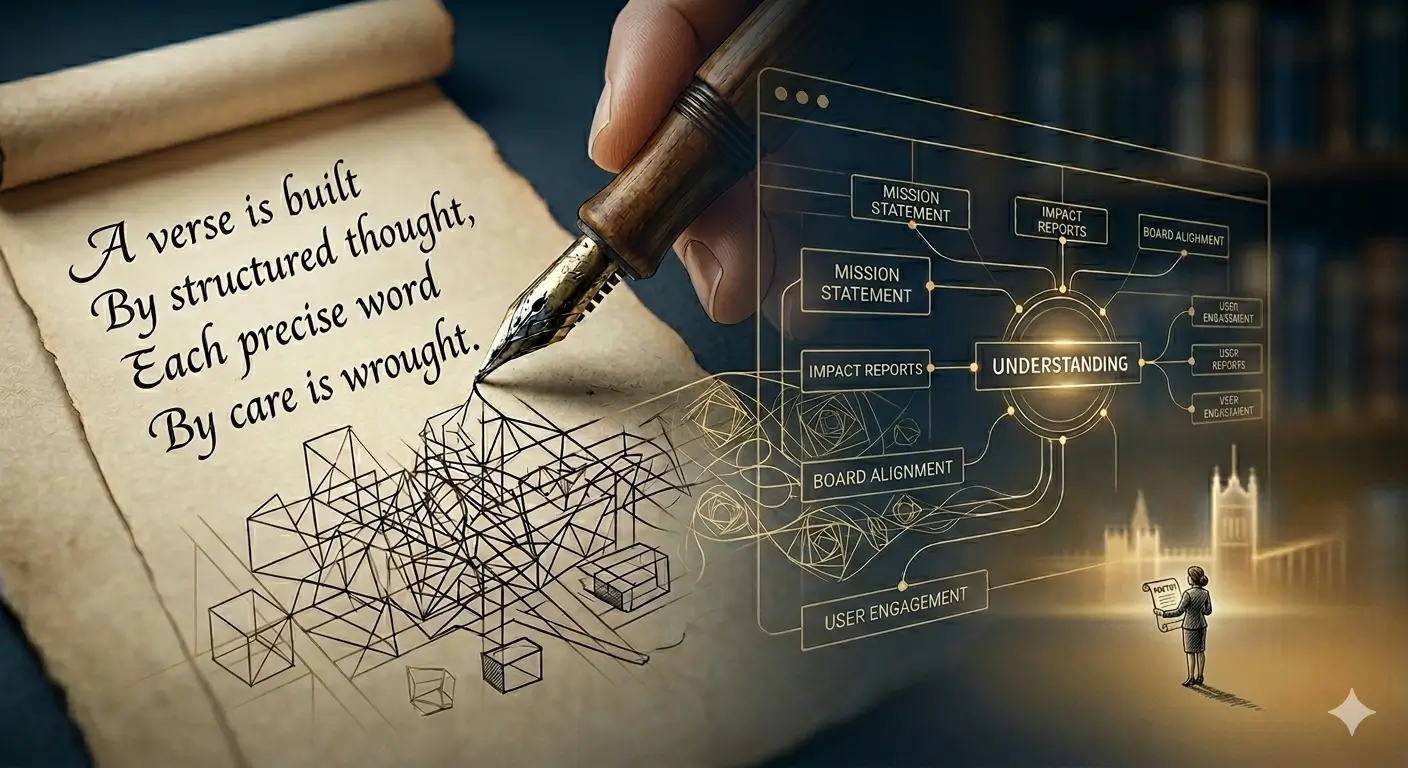
Legacy and Website Masterpieces
Legacy Is Not Inheritance
When most people hear the word legacy, they think about inheritance. What you pass down. What your children or grandchildren receive, a house, a family business, a name. But that’s not legacy.
That’s inheritance. And the distinction matters more than most organizations realize, especially when it comes to how they present themselves online.
The Test That Separates Inheritance from Legacy
Inheritance stays within your circle. It depends on proximity, relationship, and direct connection. It moves from hand to hand, generation to generation, inside a family or institution.
Legacy operates differently.
Legacy is what your work means to people who have no direct connection to you whatsoever. People who never met you. People who may not even know your name, only your contribution.
Consider the works that have endured across centuries: paintings, plays, compositions, scientific discoveries.
The people behind them are remembered not because of their descendants, but because the work itself continues to communicate.
It reaches across time and context and speaks to someone arriving with no prior relationship to the creator.
That distinction, between something that requires a personal handoff and something that stands on its own, is the same distinction mission-driven organizations need to make about their websites.
Most Institutional Websites Are Built for Inheritance, Not Legacy
Here’s the pattern I see repeatedly across nonprofits, museums, universities, healthcare systems, life science organizations and and cultural institutions: the website is built for insiders.
It assumes the visitor already knows the mission.
Already cares. Already has context for the acronyms, the program names, the organizational structure. The site works well enough for the board, the existing donor base, the internal team, the people already in the room.
But legacy doesn’t operate in the room. Legacy operates outside it.
The person who matters most to your organization’s future is the one who arrives at your website knowing nothing.
A potential funder researching quietly before reaching out.
A journalist looking for institutional credibility on a deadline.
A future partner scanning your site to decide whether you’re worth a conversation.
A community member trying to understand, for the first time, what you actually do and why it matters.
If your website can only make sense to people who already understand your organization, it is functioning as inheritance: circulating value among those already connected.
It is not building legacy. It is not reaching beyond your existing relationships to create new ones.
What a Legacy-Minded Website Actually Does
A website built for legacy operates on a fundamentally different assumption: it assumes the most important visitor has no prior context.
This doesn’t mean dumbing anything down. It means building with the same precision and intentionality that distinguishes lasting work from forgettable work in any discipline.
It means every page earns its own clarity rather than borrowing it from institutional knowledge that only insiders carry.
Practically, this looks like:
- Language that communicates your mission without requiring a glossary of internal terms
- Navigation structured around what visitors need to understand, not how your org chart is arranged
- Pages that make the case for your relevance on their own, without depending on a prior conversation or relationship to fill in the gaps
- A web presence that functions as a complete, coherent institutional voice, not a digital brochure that only works when someone from your team is standing next to it, explaining what it means
This is the difference between a website that documents your organization and one that carries it forward.
The Real Risk of the Insider Website
Organizations rarely see this as a problem because the people who approve the website already understand the organization.
The board reviews it and it makes sense to them. The executive director reads the homepage and it feels clear, because they wrote the strategic plan it references.
But the first-time visitor doesn’t have the strategic plan. They have your homepage, thirty seconds of attention, and a decision to make: does this organization seem credible, clear, and worth my time?
When the answer is unclear, not because the organization lacks substance, but because the website assumes too much, the visitor leaves.
No inquiry is submitted. No donation is made. No partnership conversation begins.
The organization never knows what it lost because the loss is invisible. The visitor simply moves on.
That’s the cost of building for inheritance rather than legacy.
The value stays inside the circle. It never reaches the people it was meant to serve.
Why We Call Them Website Masterpieces
We believe websites are works of art. Not because of how they look. Because of what they do.
A masterpiece – a painting, a play, a composition – inspires people who never met its creator. It reaches audiences across generations who have no connection to the person or the world that produced it.
No one alive today has met Shakespeare or Monet. Yet their work continues to move people, shape thinking, and open doors to understanding that would not exist without them.
That’s legacy. And that’s exactly what a website should do for a mission-driven organization.
A website masterpiece is a work of art that carries your organization’s purpose forward to people who have no prior relationship with you, and inspires them.
Not just informs them. Not just presents facts about what you do. It makes them feel the significance of your mission the way a great work of art makes you feel something true before you can fully explain why.
And like any masterpiece, it should last.
It should still inspire long after the people who built it have moved on. It should still reach new audiences, new generations of supporters, new communities – people the original creators never imagined – and make the case for why this organization matters.
Most websites are not built this way.
They are built as containers, places to hold information that makes sense to people already familiar with the organization.
When the staff turns over, when the original context fades, the site stops working. Not because the technology failed, but because it was never built to stand on its own.
It was built to be explained, not to inspire.
A masterpiece doesn’t need someone standing beside it to tell you what it means. It does that work itself, for anyone who encounters it, for as long as it exists.
That is the standard we build to. That is why we call them website masterpieces.
The question worth asking is not whether your website is up to date.
It’s whether it could inspire someone who has never heard of your organization, someone who may not arrive for another ten years: to understand what you do, why it matters, and why they should care.
That’s what it means to build something that lasts.
“If you’re going to live, leave a legacy. Make a mark on the world that can’t be erased.” – Maya Angelou
Our website was redesigned two years ago. How do we know if it’s an insider website?
Show your homepage to someone with no connection to your organization and ask them to explain what you do and why it matters. If they struggle, your site is built for insiders regardless of how recently it was redesigned. Recency doesn’t equal clarity.
We have multiple audiences: donors, community members, partners, media. How do we write for strangers without losing specificity?
The stranger test isn’t about writing generically. It’s about ensuring your core message makes sense without insider context. Once that foundation is clear, specific audiences can navigate to the detail they need. The mistake is assuming specificity requires shared background knowledge.
Our board reviews and approves the website. Isn’t that sufficient quality control?
Board approval confirms internal accuracy, not external clarity. Your board members already understand the mission, the strategy, and the context. The gap isn’t whether the content is correct, it’s whether someone without that background can understand it on their own.
How is this different from just improving our UX or rewriting our copy?
UX improvements and copy rewrites address symptoms. The inheritance-versus-legacy distinction addresses the underlying assumption your website is built on – who it’s actually for. Until you resolve that question, better copy and smoother navigation still serve the wrong audience.

Author Bio
Frances Naty Go is the founder and Website Systems Architect of Goldlilys Media, a San Diego web systems consultancy established in 2013. She builds website masterpieces for museums, cultural institutions, nonprofits & mission-driven organizations in healthcare and life sciences: structured sites that educate, earn trust, and stay easy for teams to update for years.
Frances has built websites professionally since 2010 and has supported the Balboa Park Online Collaborative’s web systems since 2015. A UC San Diego Computer Science graduate, she leads both strategy and build on every engagement, combining durable architecture, SEO, and AI visibility so the organizations she serves are found, understood, and trusted.
Does Your Website Still Fit Where You're Headed?
A five-part checklist to help museums, nonprofits, and mission-driven organizations assess whether your website needs a redesign, a rebuild, or something else entirely.