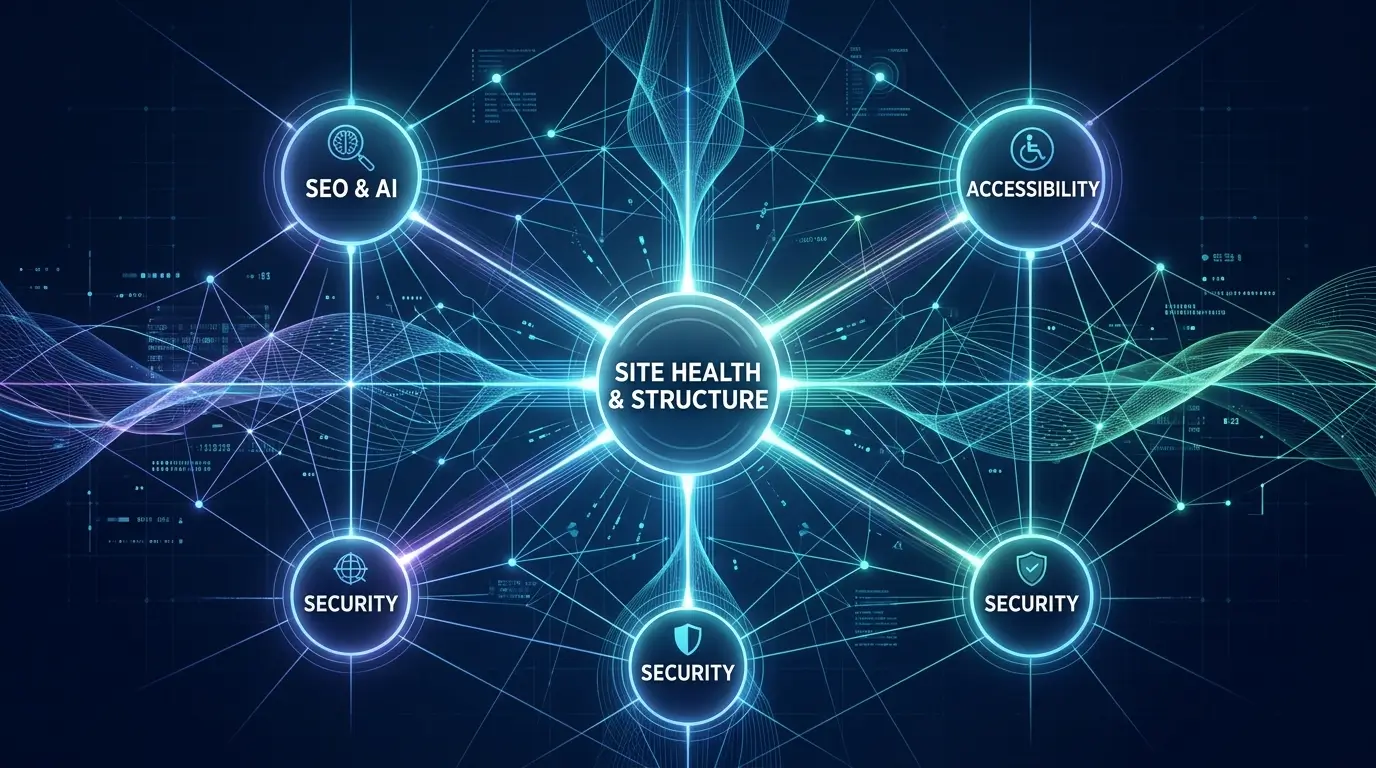

Why a Website Is a System, Not a Collection of Pages
When something goes wrong on an institutional website, the instinct is to fix the part that is visibly broken.
A page loads slowly – update the image.
A form stops working – contact the developer.
A section looks outdated – rewrite the copy.
This approach treats a website as a collection of independent parts. It is the reason most institutional websites accumulate problems quietly until the cumulative damage becomes impossible to ignore.
A website is not a collection of pages. It is a system, and systems behave differently than their individual components suggest.
What a website system is actually made of
Every institutional website has four interdependent layers that work together to create the experience a visitor has.
The structural layer is the foundation: the platform, the hosting environment, the database, and the architecture decisions made at the time of the build. Like the skeletal system of an organization, it determines what is possible. A structural layer built for a smaller, simpler organization cannot support the complexity of an institution that has grown without becoming a liability.
The presentation layer is what visitors see and interact with: the layout, the typography, the imagery, the navigation. This layer communicates before a word is read. A presentation layer that has not been updated in three years communicates that the organization has not been attended to in three years, regardless of what the content says.
The content layer is where the organization’s voice lives: what is said, how it is organized, whose perspective is centered, and what the evidence is for what is claimed. Content that has not been updated as the organization has evolved creates a credibility gap that sophisticated visitors notice before they engage.
The operational layer is what keeps the system functioning over time: security updates, performance monitoring, backup verification, plugin compatibility, and the ongoing adjustments required as technology and organizational needs change. This layer is invisible when it is working and immediately costly when it is not.
Why these layers cannot be managed independently
The reason institutional websites fail is rarely that one layer is broken. It is that the layers are no longer working together.
- A presentation layer that has been visually refreshed without updating the structural layer sits on a foundation that cannot support what the new design requires
- A content layer that has been updated without updating the operational layer is carrying current information on a platform that has not been maintained
- A structural layer that has been technically upgraded without updating the presentation and content layers looks current in the backend and dated to every visitor
This is why incremental fixes so often disappoint. The organization addresses the visible problem without addressing what made it possible. The system continues to underperform because the underlying interdependence has not been considered.
What systems thinking requires from institutional leadership
Treating a website as a system is not a technical decision. It is an organizational one.
It means someone is accountable for the whole, not just the parts that are visibly broken. It means updates in one layer are evaluated for their effect on adjacent layers. It means the organization has a clear picture of what the site needs to accomplish, for which visitors, before making any changes to how it is built or what it says.
Organizations that think about their websites as systems make fewer decisions, spend less over time, and get more durable results than organizations that manage each layer in isolation. The investment is not larger. The thinking is more integrated.
Frequently Asked Questions
Why does fixing one part of a website often seem to create problems elsewhere?
Because a website is an interdependent system. A change to the presentation layer: a design update, a new theme – can affect how the structural layer performs. A content reorganization can break internal links that the operational layer was not monitoring. Each layer influences the others, which is why changes made without understanding the full system often produce unexpected results.
How do we know if our website is being managed as a system or as a collection of parts?
The clearest signal is how decisions get made. If your organization addresses website problems reactively, fixing what is visibly broken when it becomes urgent, you are managing parts. If someone is accountable for the whole system, updates happen on a rhythm, and changes are evaluated for their effect on adjacent layers, you are managing a system. The difference shows up in cost, continuity, and how much staff time the website consumes over time.
At what point does an institutional website need to be rebuilt rather than maintained?
When the structural layer can no longer support what the organization needs the site to do. Surface problems, outdated content, stale imagery, inconsistent language, respond to ongoing maintenance. Structural problems: a platform that cannot support the organization’s complexity, an architecture that reflects a different strategic period, a foundation that cannot accommodate growth without breaking, require a more deliberate intervention. The Executive Website Clarity Assessment was built to make that distinction clearly before any investment is committed.

Author Bio
Frances Naty Go is the founder and Website Systems Architect of Goldlilys Media, a San Diego web systems consultancy established in 2013. She builds website masterpieces for museums, cultural institutions, nonprofits & mission-driven organizations in healthcare and life sciences: structured sites that educate, earn trust, and stay easy for teams to update for years.
Frances has built websites professionally since 2010 and has supported the Balboa Park Online Collaborative’s web systems since 2015. A UC San Diego Computer Science graduate, she leads both strategy and build on every engagement, combining durable architecture, SEO, and AI visibility so the organizations she serves are found, understood, and trusted.
Does Your Website Still Fit Where You're Headed?
A five-part checklist to help museums, nonprofits, and mission-driven organizations assess whether your website needs a redesign, a rebuild, or something else entirely.