
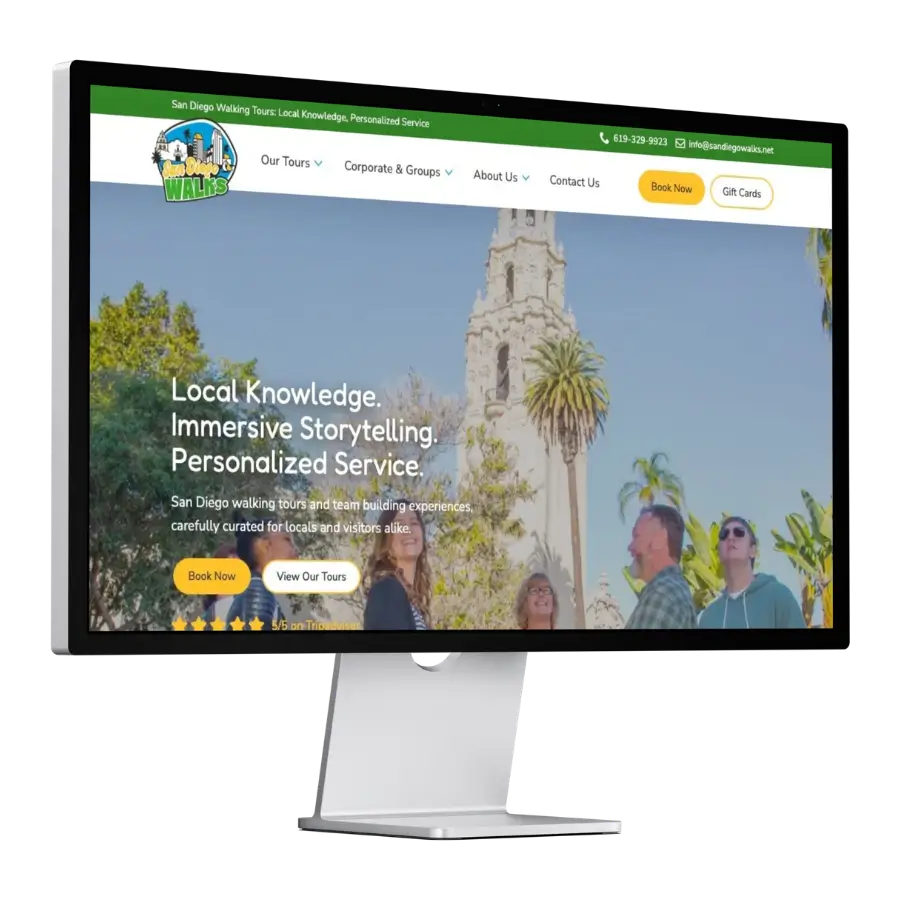
The situation, before
Jennifer could not make changes to her own website. Every update, a new tour listing, a schedule change, a seasonal offer, had to go through her previous developer, and requests took a long time to turn around. The site had been built on a proprietary theme, one that would not function if moved to another server or host.
The real problem diagnosed
The visible complaint was a slow developer. The actual condition was structural dependency. A faster developer would not have solved it, because the constraint was built into the platform itself.
Jennifer was not choosing to wait, she had no way around waiting. The proprietary theme made her a tenant on her own website rather than the owner of it.
What was at stake
For a small, owner-operated tour business, the website carries jobs a larger institution can spread across a team: bookings, current tour listings, pricing, seasonal promotions. Every delay in updating it cost Jennifer control over how her business presented itself, in real time, to travelers deciding same-week or same-day. Left unaddressed, she would have stayed locked to one vendor indefinitely, with no path off the platform without eventually facing a full rebuild anyway.
The path forward
Because the constraint was the platform itself, not any one broken page, a patch or a migration would not resolve it. The proprietary theme was built in a way that made it unmovable. The decision was to rebuild from the ground up, keeping Jennifer’s existing branding and a layout close to what already worked for her guests, but on a modern, open builder that put content control back in her hands rather than a developer’s queue.
What was built
A new site rebuilt on Breakdance, preserving San Diego Walks’ existing branding and a layout close to the original, so returning visitors and past guests found a familiar experience rather than a relaunch that erased what already worked. SEO and AI search visibility work completed after launch, positioning the site to be found through both traditional search and newer AI-driven discovery. Step-by-step training manuals currently being built for Jennifer, ahead of hands-on training, so she can make her own routine updates without waiting on a developer.
Decision logic
A lighter fix was not available. Migrating or patching the existing site was not an option: the proprietary theme was built specifically not to survive a move. Rebuilding was the only way to remove the dependency rather than relocate it. Keeping the branding and layout intact meant the fix solved the ownership problem without asking Jennifer to trade away what her guests already recognized.
Lock-in insight: for a business this size, the fix that matters isn’t a better developer relationship. It’s no longer needing one for the basics.
Results
Google PageSpeed Insights scores improved from 60 (desktop) and 40 (mobile) on the previous site to 100 (desktop) and 94 (mobile) on the rebuild, with accessibility, best practices, and SEO scores of 94 to 100 across both. SEO and AI search visibility work is complete.
Training and documentation are underway. The next milestone is Jennifer operating the site independently, with monthly maintenance under discussion as an ongoing relationship.
What comes next
Training manuals are being built now, ahead of hands-on training with Jennifer so she can manage day-to-day content herself. Monthly maintenance is the expected direction, continuing the SEO and technical stewardship rather than ending at launch.